Big Fat Lies by David Gillespie
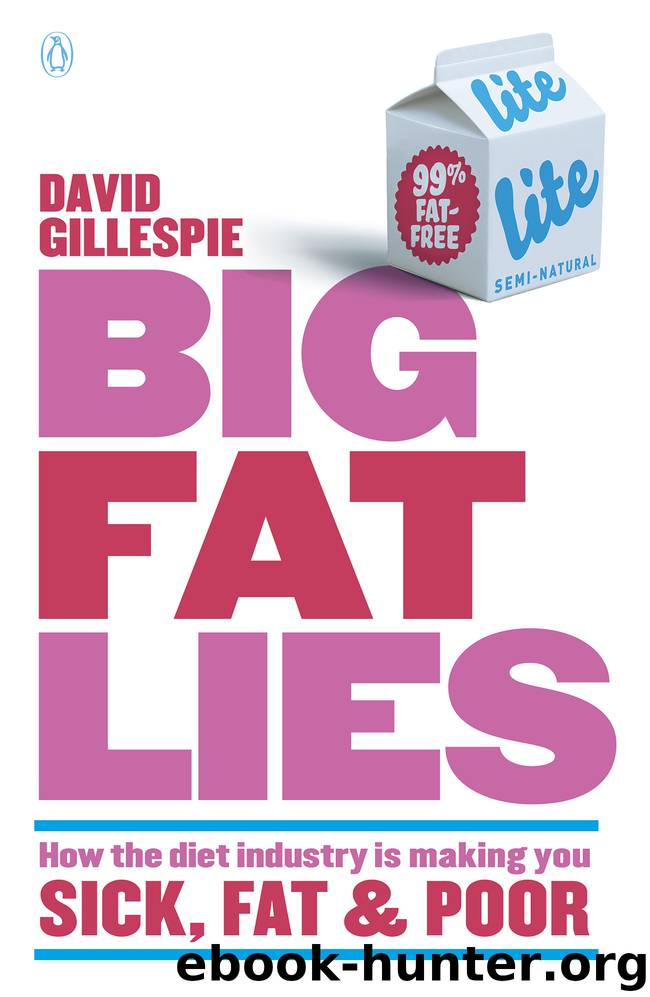
Author:David Gillespie
Language: eng
Format: epub
ISBN: 9781742534824
Publisher: Penguin Group Australia
Published: 2012-02-22T05:00:00+00:00
Ancel Keys, cholesterol and heart disease
In 1939, Ancel Keys, a 31-year-old marine biologist, joined the Mayo Foundation, run by the University of Minnesota in Rochester, Minnesota, where he created the Division of Human Physiology and Biochemistry. The following year he was invited to organise what was to become the Laboratory of Physiological Hygiene at the university’s main campus in Minneapolis. By this time, World War II was engulfing Europe, and America’s involvement was becoming more certain by the day. The US Department of Defense was one of the biggest paying customers of Keys’s new lab, and one of his first contracts was to run subsistence tests for the department.
The Defense Department had to keep an eye on its budget, so Keys’s first major assignment was to determine the least amount of food required to keep a combat soldier alive and in fighting condition. The Army wanted a complete meal small enough to fit into a soldier’s pocket, so Keys and his team scoured the local shops to create what was essentially a lunchbox full of high-calorie, long-life foods. Each waterproof box contained a tin of meat or cheese, biscuits, a chocolate bar and hard candy, coffee, soup powder, chewing gum, toilet paper and, of course, cigarettes. The infamous K-rations (‘K’ for Keys) became – and remain, albeit heavily modified – a staple of the US military. Overnight, Ancel Keys became one of the first ever experts in human nutrition. By 1941, he was special assistant to the Secretary of War.
The starvation studies Keys carried out on conscientious objectors during the war (see Chapter 1) gave him access to significant government population health and food data coming out of post-war Europe. Looking at these data, Keys noticed that, as food supplies reached starvation levels, the death rate from coronary heart disease dropped significantly. He couldn’t explain that counterintuitive observation – surely more people should be dying of heart attacks as they starved, not fewer.
Keys developed a theory to explain the data. He thought that a full-calorie diet contained more animal products and fat and therefore more cholesterol than a starvation diet. He knew of Anitschkow’s experiments and theorised that, just as with rabbits, if there’s too much cholesterol in the blood of well-fed Europeans, it can accumulate and cause atherosclerosis, and this could lead to heart attack or stroke. Starving people reduced their fat (and therefore cholesterol) intake, and had fewer heart attacks.
Download
This site does not store any files on its server. We only index and link to content provided by other sites. Please contact the content providers to delete copyright contents if any and email us, we'll remove relevant links or contents immediately.
How to Be a Bawse: A Guide to Conquering Life by Lilly Singh(7545)
Deep Work by Cal Newport(7160)
The Longevity Diet by Valter Longo(5100)
The Fat Loss Plan by Joe Wicks(4955)
The Four-Pack Revolution by Chael Sonnen & Ryan Parsons(3997)
The Ultimate Bodybuilding Cookbook by Kendall Lou Schmidt(3979)
The French Women Don't Get Fat Cookbook by Mireille Guiliano(3704)
Not a Diet Book by James Smith(3480)
Super Food Family Classics by Jamie Oliver(3456)
Factfulness_Ten Reasons We're Wrong About the World_and Why Things Are Better Than You Think by Hans Rosling(3264)
Turn Up Your Fat Burn! by Alyssa Shaffer(3244)
Self-Esteem by Matthew McKay & Patrick Fanning(3174)
Tom Kerridge's Dopamine Diet: My low-carb, stay-happy way to lose weight by Kerridge Tom(3129)
Body Love by Kelly LeVeque(3086)
The Unbecoming of Mara Dyer by Michelle Hodkin(3073)
Tone Your Tummy Type by Denise Austin(2872)
The Fat Chance Cookbook by Robert H. Lustig(2867)
LL Cool J's Platinum 360 Diet and Lifestyle by LL Cool J(2761)
Men's Health Best by Men's Health Magazine(2631)
